
Workshop on Quantum Algorithms (QA)
This workshop is part of the Research Semester Programme “Quantum Algorithms and Quantum Error Correction”. It will feature a light programme of talks, with plenty of time for collaboration and informal discussion. The theme of the workshop is quantum algorithms, and we welcome contributed talks connected to this broad area. Potential topics include, but are not limited to, transducers, optimization, query complexity, Gibbs sampling, quantum walks, and testing/learning.
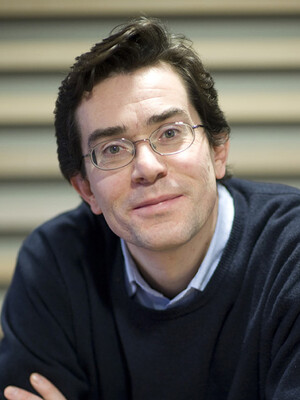

Ronald de Wolf Aleksandrs Belovs (Univ of Latvia)
(QuSoft, CWI, UvA, Google Quantum AI)
Participants who wish to give a contributed talk may indicate a title and abstract in the registration form. If a large number of contributed talks is proposed, we may not be able to accommodate all of them in the programme. We nevertheless encourage participants to propose talks that fit the theme of the workshop. A running list of talks and speakers will be posted and updated as participants register.
We also encourage participants to submit “open problems” in quantum algorithms that they think are timely and would benefit from a burst of sustained attention. We will curate these problems into a list to help guide discussions during the workshop. We may ask you to give a short impromptu presentation about your problem at the start of the workshop, though you can of course submit problems without choosing to present. You can submit open problems by directly emailing Sebastian Zur at sebastian dot zur at cwi dot nl
Wednesday 16 September
9.30 to 10.00: Coffee/registration
10.00 to 11.00: Ronald de Wolf (QuSoft, CWI, Univ of Amsterdam, Google Quantum AI):
Some Sieving Attacks on Post-Quantum Cryptography
11.00 to 11.30: Coffee
11.30 to 12.00: Shrinidhi Teganahally Sridhara (LaBRI, Université de Bordeaux):
Quantum Sampling of Random Spanning Trees
12.00 to 12.30: Maximilian J. Kramer (Freie Universität Berlin):
Complexity-theoretic goalposts for DQI via PCP-theory
12.30 to 13.00: Armando Bellante (Max Planck Institute of Quantum Optics):
The power of oracle access; The quantum complexity of the abelian state hidden subgroup problem
13.00 to 14.30: Lunch
14.30 to 15.30: Aleksandrs Belovs (University of Latvia): Tight quantum lower bound for k-distinctness
15.30 to 16.00: Coffee
16.00 to 18.00: Open problems / discussions
18.00: Reception
Thursday 17 September
9.30 to 10.00: Coffee/registration
10.00 to 11.00: Arkopal Dutt (IBM Research): Learning stabilizer structure of quantum states
11.00 to 11.30: Coffee
11.30 to 12.00: Rahul Bandyopadhyay (Leiden University):
Provable learning separation for predicting time-evolution of quantum many-body systems
12.00 to 12.30: Franz J. Schreiber (Freie Universität Berlin):
Learning k-body Hamiltonians via sublinear-time sparse recovery
12.30 to 13.00: Marten Folkertsma (QuSoft, Univ of Amsterdam):
Doing More with the Same Qubits; Catalytic Techniques in Quantum Space
13.00 to 14.30: Lunch
14.30 to 15.00: Damiano Aliverti (LMU Munich):
Quasisymmetry-based VQE enhanced by quantum subspace expansion for electronic structure Hamiltonians
15.00 to 15.30: Elies Gil-Fuster (Freie Universität Berlin, Heinrich Hertz Institut Berlin):
Optimal algorithmic complexity of inference in quantum kernel methods
15.30 to 16.00: Coffee
16.00 to 18.00: Open problems / discussions
18.30: Dinner
Friday 18 September
9.30 to 10.00: Coffee/registration
10.00 to 11.00: Andris Ambainis (University of Latvia): Lower bounds for hybrid quantum classical algorithms
11.00 to 11.30: Coffee
11.30 to 12.00: Francisco Escudero Gutiérrez (Inria):
Optimal inequalities for completely bounded polynomials and the limitations of quantum query algorithms
12.00 to 12.30: Arne Darras (Université Libre de Bruxelles):
Fractional and continuous-time quantum query complexity
12.30 to 13.00: Sebastian Zur (CNRS, IRIF): A Tight Time-Space Lower Bound for Label-Symmetric Collision Finding
13.00 to 14.30: Lunch
14.30 to 16.00: Open problems / discussions
Participants
Alberto Zorzato (QuSoft, University of Amsterdam)
Aleksandrs Belovs (University of Latvia)
Alexander Ikonomou (Saarland University)
Alexander Kulpe (LMU Munich)
Amolak Ratan Kalra (TU Delft)
András Gilyén (Alfred Renyi Institute of Mathematics)
Andris Ambainis (University of Latvia)
Arghavan Safavi (QuSoft, University of Amsterdam)
Arjan Cornelissen (University of Cambridge)
Arkopal Dutt (IBM Research)
Armando Bellante (Max Planck Institute of Quantum Optics)
Arne Darras (Université libre de Bruxelles)
Benjamin Mathieu-Bloise (CNRS, IRIF, Université Paris Cité)
Christian Schaffner (QuSoft, University of Amsterdam)
Dale Jacobs (Tufts University)
Damiano Aliverti (LMU Munich)
David Mestel (Maastricht University)
Dubus Benoît (Université libre de Bruxelles)
Elies Gil-Fuster (Freie Universität Berlin, Heinrich Hertz Institut Berlin)
Fedor Kuyanov (University of Amsterdam)
Florian Speelman (QuSoft, University of Amsterdam)
Francisco Escudero Gutiérrez (Inria)
Franz J. Schreiber (Freie Universität Berlin)
Freek Witteveen (CWI)
Galina Pass (QuSoft)
Guoding Liu (CWI)
Jérémie Roland (Université libre de Bruxelles)
Joppe Stokvis (QuSoft, Leiden University)
Joseph Cunningham (Université de Bordeaux)
Josh Blake (Phasecraft, University of Bristol)
Julien Ladeuze (Université libre de Bruxelles)
Junqiao Lin (QuSoft, CWI)
Manideep Mamindlapally (CWI, University of Amsterdam)
Maris Ozols (QuSoft, University of Amsterdam)
Marten Folkertsma (QuSoft, University of Amsterdam)
Maximilian J. Kramer (Freie Universität Berlin)
Nadya Voronova (IRIF, CNRS)
Nithish Raja (Eindhoven University of Technology)
Philippe van Dordrecht (QuSoft, CWI)
Rahul Bandyopadhyay (Leiden University)
Robin Kothari (Google Quantum AI) Roman Edenhofer (IRIF, Université Paris Cité)
Ronald de Wolf (QuSoft, CWI, University of Amsterdam, Google Quantum AI)
Sander Gribling (Tilburg University)
Sayantan Sen (National University of Singapore)
Sebastian Zur (CNRS, IRIF)
Shabnam Ghalichi (University of Amsterdam)
Shrinidhi Teganahally Sridhara (LaBRI, Université de Bordeaux)
Simon Apers (CNRS, IRIF)
Stacey Jeffery (QuSoft, CWI)
Subhasree Patro (Eindhoven University of Technology)
Thomas van Meer (University of Amsterdam)
Tuyen Nguyen (University of Technology Sydney)
Victor Braun (QuSoft)
Yassine Hamoudi (CNRS, LaBRI, Université de Bordeaux)
Yingjian Liu (Leiden University)
Yixin Shen (Inria, Université de Rennes)
Yuxin Zhang (Alfred Renyi Institute of Mathematics)