
Quantum Physics and Logic 2026: Scientific Highlights
The 23rd International Conference on Quantum Physics and Logic (QPL 2026) brought nearly 200 quantum researchers, computer scientists, and mathematicians to the University of Amsterdam, Roeterseiland campus between August 15th and 21st, 2026. This year’s gathering marked the largest QPL conference in its 23 years history, spanning seven days of workshops, a job fair, and three parallel technical tracks.
Source: QuSoft website
August 24, 2026
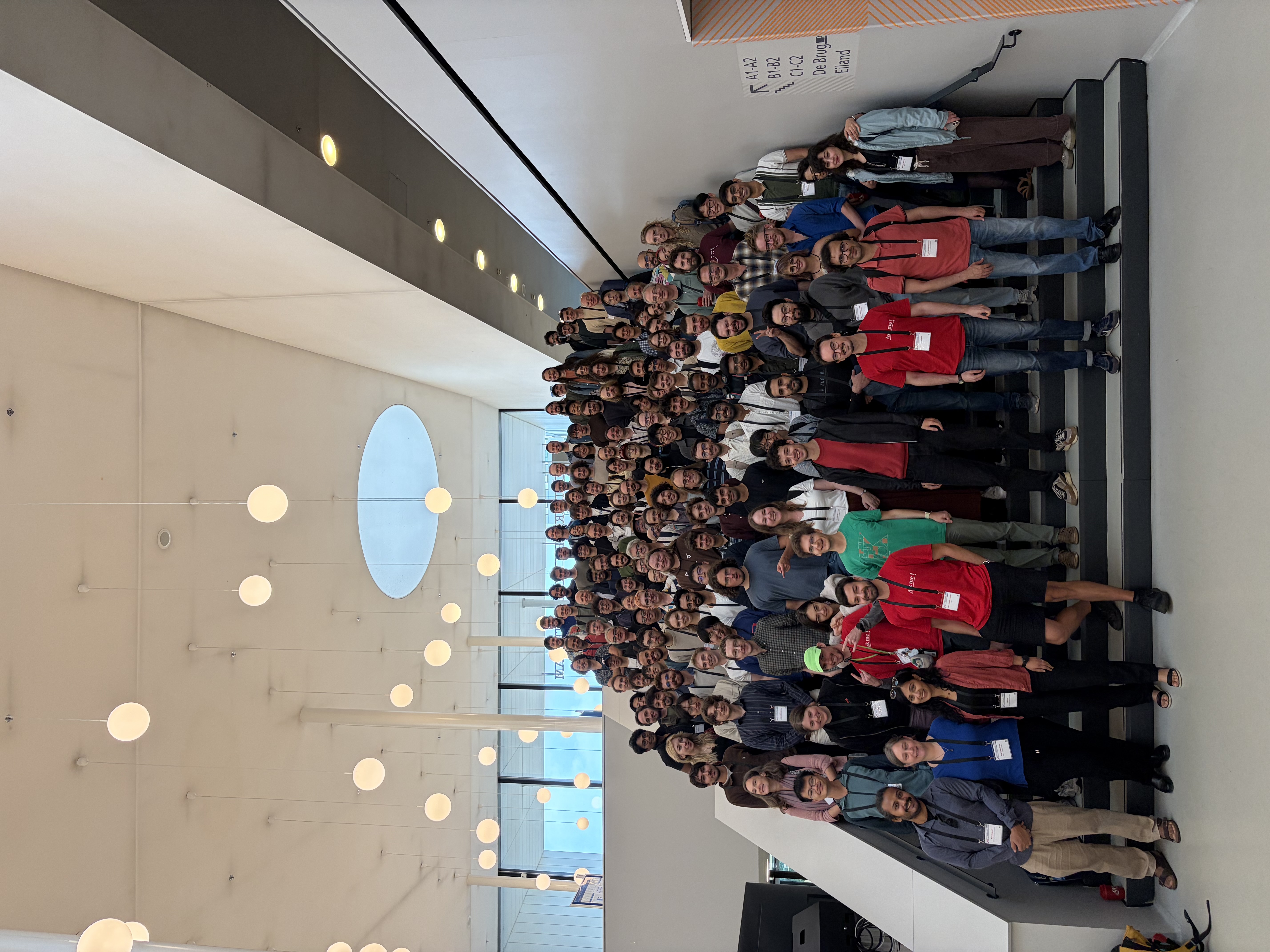
To understand QPL’s role in the quantum ecosystem, we spoke with QuSoft researcher John van de Wetering, who reflected on how it has evolved over two decades.
Building the mathematical foundation of quantum science through logic
Founded in the early 2000s as Quantum Programming Languages, the conference soon rebranded to Quantum Physics and Logic to broaden its scope. Fostered in its early years by pioneers like Bob Coecke and the Oxford Quantum Group in computer science, QPL pioneered the use of category theory, an abstract branch of mathematics, to study quantum information.
Over time, this foundational approach sprouted entirely new sub-communities exploring the deepest questions in physical theory. Researchers examine indefinite causality, asking how our understanding of cause-and-effect transforms in a quantum world where events are no longer restricted to a fixed, classical sequence, and whether this counterintuitive property yields a computational advantage. Other teams apply these tools to quantum gravity, studying how physical laws behave at fundamental scales where classical spacetime breaks down. Meanwhile, work in generalized physics tests hypothetical physical frameworks to identify the precise mathematical properties that separate quantum mechanics from other conceivable theories.
Selection of themes and highlighted scientific results
To illustrate the breadth of fundamental science presented at QPL 2026, we selected a number of conference’s main themes and mapped them to specific results that were presented:
Fault Tolerance: Building error-protected, noise-resilient quantum devices using diagrammatic tools.
Paper: Fault tolerance by construction (Rodatz et al., 2026)
Instead of designing ideal quantum circuits and retrofitting error corrections afterward, this work uses modified ZX-calculus rules to automatically transform high-level quantum algorithms directly into hardware-implementable, error-protected circuits.
Causality in a Quantum World: Quantum mechanics allows event sequences to exist in a superposition of orders (where event A happens both before and after event B).
Paper: Efficient quantum-circuit simulation of classical control of causal order (Mothe & Bavaresco, 2026)
This research provides an efficient framework to simulate “quantum switches”: systems where classical control signals dictate the execution order of quantum operations, offering a structured blueprint for testing exotic causal advantages on standard quantum computers.
Contextuality and Quantum Speedup: Contextuality occurs when different parties share entangled correlations, which results in outcomes that cannot be explained by classical physics. Measuring how far are the results from the classical limits provides a metric for “quantumness”. In practical terms this means understanding which fundamental resources enable quantum computational speedups.
Paper: Algebraic paradoxes in adaptive quantum computation (Abramsky et al., 2026)
In measurement based quantum computing, the machine updates the next steps “on the fly” using feedback from early measurements. The authors show that when this process outperforms a classical computer, it relies on a specific mathematical structure called an algebraic paradox. In simple terms, the quantum system allows a set of local relationships that, if written as classical logic, would contradict each other. Quantum speedup comes directly from these non-classical mathematical contradictions.
Generalized Probabilistic Theories (GPTs): Testing mathematical frameworks broader than quantum mechanics allows to determine which features (like teleportation or spin statistics) are unique to nature.
Paper: Invariance under quantum permutations rules out parastatistics (Mekonnen et al., 2025)
Fundamental particles in nature are strictly limited to bosons and fermions, even though quantum mechanics mathematically permits exotic alternatives called “paraparticles”. The authors prove why these exotic paraparticles cannot exist in our physical world, showing that nature only permits bosons and fermions.
Measurement-Based Quantum Computing (MBQC): MBQC is based on performing computations by making sequential measurements on heavily entangled states instead of applying traditional logic gates.
Paper: Completeness for flow-preserving rewrite rules (Backens & Perdrix, 2026)
To optimize measurement-based quantum programs, compilers need to rewrite complex quantum networks into simpler ones. This paper proves a complete set of transformation rules that guarantees information won’t get stuck or lost during those rewrites, paving the way for safer, automated quantum software compilers.
ZX calculus broadly used across research fields
A recurring theme at QPL is that abstract mathematical tools often yield surprising real-world applications years down the line.
“When you keep looking at foundational aspects, if you keep pushing for a long time, in the end you get applications in places you would have never expected. ZX-calculus is a prime example of this.” — John van de Wetering
Originally developed purely within mathematical logic, ZX-calculus: a visual language for quantum processes analogous to Feynman diagrams in physics, has evolved into an important tool for circuit optimization, classical simulation, and understanding the nature of quantum fault tolerance. The conference has shown many researchers are now embracing zx-calculus in their work, which shows how fundamental theory can provide for elegant and functional tools that are a practical asset for the community.
References
Abramsky, S., Barbosa, R. S., Constantin, C., & Karvonen, M. (2026). Algebraic paradoxes in adaptive quantum computation. arXiv. https://doi.org/10.48550/arXiv.2607.26157
Backens, M., & Perdrix, S. (2026). Completeness for flow-preserving rewrite rules. arXiv. https://doi.org/10.48550/arXiv.2608.13035
Mekonnen, M., Galley, T. D., & Müller, M. P. (2025). Invariance under quantum permutations rules out parastatistics. arXiv. https://doi.org/10.48550/arXiv.2502.17576 Cited by: 12
Mothe, R., & Bavaresco, J. (2026). Efficient quantum-circuit simulation of classical control of causal order. In Proceedings of the 23rd International Conference on Quantum Physics and Logic (QPL 2026) (Paper 136). https://qplconference.org/assets/submissions/non-final/qpl2026-paper136.pdf
Rodatz, B., Poór, B., & Kissinger, A. (2026). Fault tolerance by construction. In Proceedings of the 23rd International Conference on Quantum Physics and Logic (QPL 2026) (Paper 96). https://qplconference.org/assets/submissions/non-final/qpl2026-paper96.pdf
To learn more about zx-calculus: The ZX-calculus, https://github.com/zxcalc/book.